
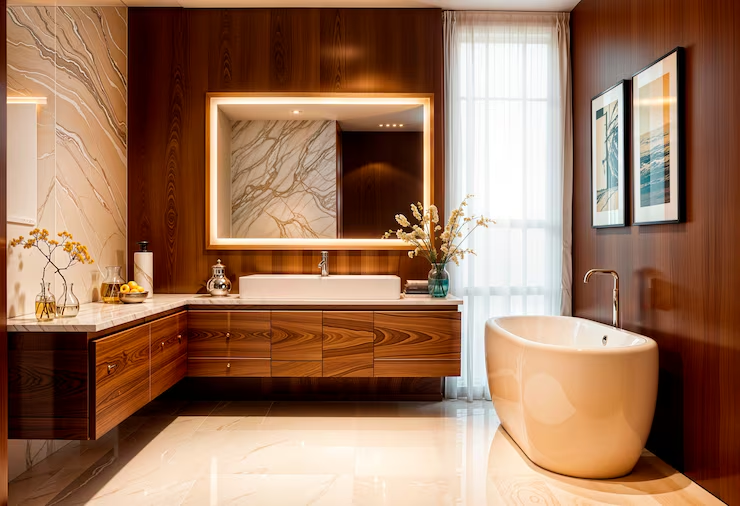

A bathroom doesn’t need to be large to feel open. What matters is how the space is perceived. Many small bathrooms feel cramped not because of their size, but because every surface is visually busy, every corner is occupied, and the eye has nowhere to rest.
Spaciousness is a feeling, not a measurement.
When a bathroom feels spacious, the body relaxes. Movement becomes easier. The room stops feeling like something to work around and starts feeling like something to move within.
That shift comes from a few quiet principles.
Visual Simplicity Creates Breathing Room
Crowded surfaces shrink a room.
When counters are filled, shelves are packed, and walls hold many competing elements, the space feels compressed. The eye is constantly interrupted.
Spacious bathrooms allow the eye to travel.
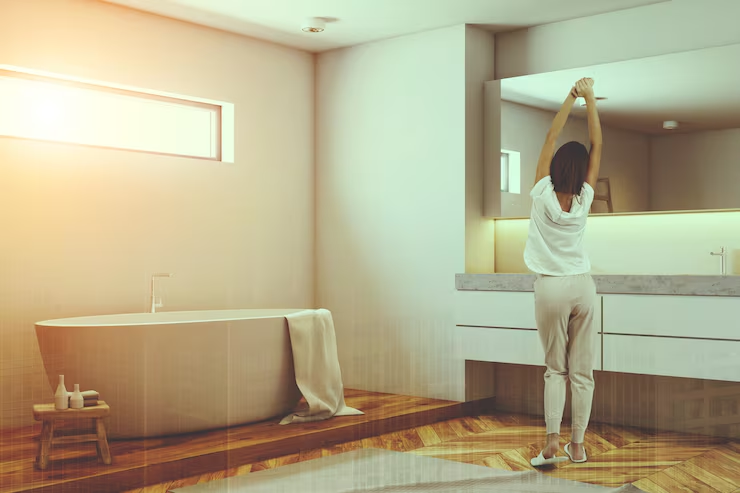
This doesn’t mean removing everything. It means letting some surfaces remain open.
- Keep part of the counter clear
- Limit wall decor to one or two pieces
- Avoid stacking unrelated items
Space between objects creates depth.
Depth creates openness.
The room feels larger because the eye can move without resistance.
Light Expands Perception
Light is one of the strongest tools for creating space.
A dim or unevenly lit bathroom feels smaller than it is. Shadows compress corners. Harsh glare flattens surfaces.
Even, gentle light opens the room.
- Use warm bulbs instead of cool ones
- Add a secondary light source to soften shadows
- Allow natural light to filter rather than block
When light moves freely, the room feels less enclosed.
Mirrors amplify this effect by reflecting brightness and extending visual boundaries.
The room appears to continue beyond its walls.
Consistent Color Reduces Fragmentation
Too many colors divide a small space into pieces.
Each contrast creates a visual stop.
A narrow color palette allows the room to read as one continuous volume.
Soft whites.
Warm neutrals.
Muted tones.
When walls, towels, and surfaces speak the same quiet language, the room feels unified.
Unity feels spacious.
Even in a tiny bathroom, visual continuity creates the impression of expansion.
Vertical Space Changes Scale
Many bathrooms feel small because everything happens at eye level.
Using vertical space shifts that perception.
- Tall, narrow shelves
- Hooks placed higher
- A mirror that extends upward
The eye is drawn vertically.
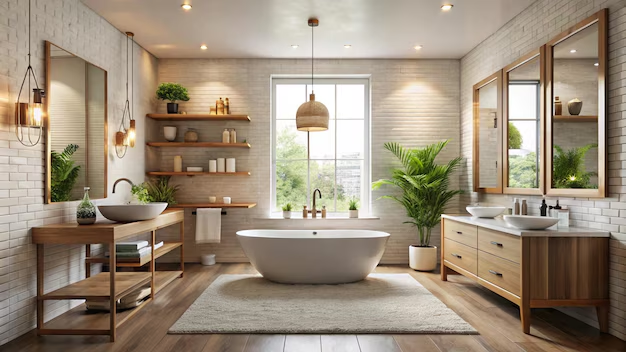
The room feels taller.
Height suggests openness, even when width is limited.
This subtle redirection changes how the space is experienced.
Order Without Rigidity
Clutter makes a room feel tight.
But hiding everything can make it feel sterile.
Spacious bathrooms balance order with ease.
- Use baskets under the sink
- Group daily items on a tray
- Store extras out of sight
When items have a place, movement becomes fluid.
You stop navigating around things.
The room feels cooperative.
That cooperation reads as space.
Let Materials Breathe
Heavy textures and dark finishes absorb light.
Lighter materials reflect it.
Glass, light wood, soft stone, and neutral fabrics keep the room from feeling dense.
Even small choices matter:
- A fabric shower curtain instead of opaque plastic
- A light-colored bath mat instead of a dark one
- Open shelving instead of bulky cabinets
The room begins to feel porous rather than sealed.
Porosity suggests openness.
Why This Matters
A spacious-feeling bathroom isn’t about illusion.
It’s about comfort.
When the room feels open:
- Movement is easier
- The mind relaxes
- The body slows
The bathroom stops feeling like a constraint.
It becomes a place to pause.
Spaciousness doesn’t come from more square footage.
It comes from fewer interruptions.
And when a space stops interrupting you, it begins to support you.
AI Insight: Over time, people often notice that spaces feel larger not when they contain more, but when they allow the eye and body to move without resistance.


