
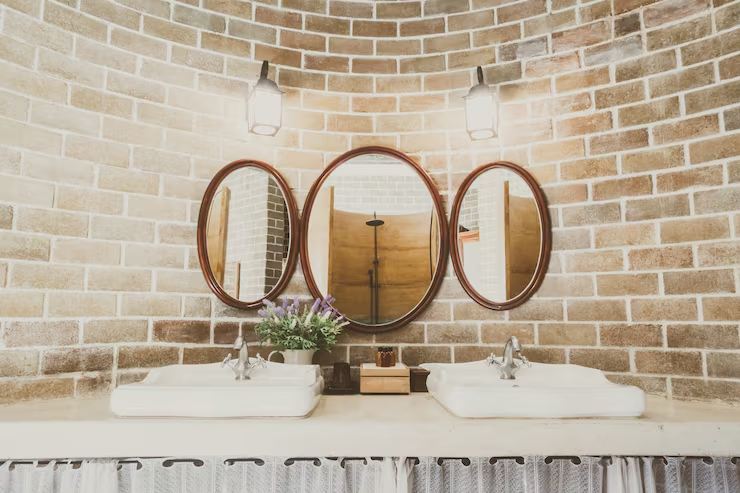

A calm bathroom doesn’t try to impress. It doesn’t compete for attention. It quietly supports the moments that happen there—waking up, winding down, resetting in between.
Most bathrooms are designed to be efficient. Bright lights. Hard surfaces. Functional storage. Everything works, but nothing slows you down.
Decor that feels calm changes that rhythm.
It doesn’t add drama.
It reduces noise.
It creates space for the eye and body to rest.
Calm is not created by adding more. It’s created by choosing less, more intentionally.
Let the Space Breathe
The fastest way to make a bathroom feel calmer is to reduce visual pressure.
Too many objects on the counter.
Too many colors in one view.
Too many small items competing.
Calm begins when the eye can land somewhere and stop.
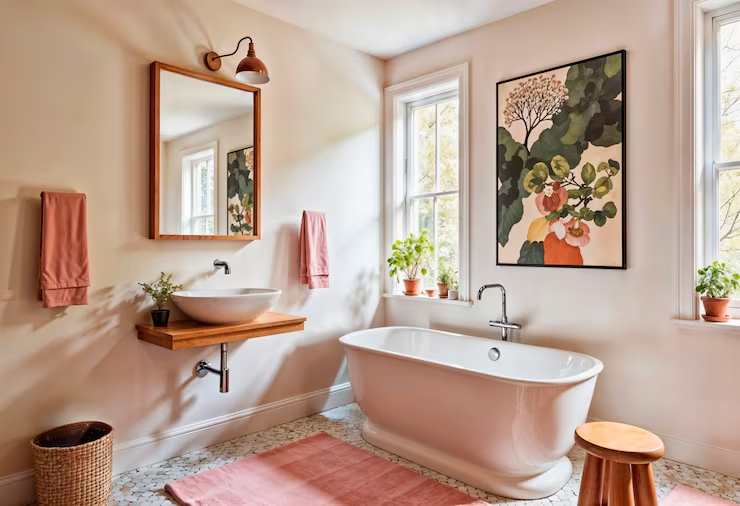
Choose one or two surfaces to keep mostly clear. Let a single tray, soap dispenser, or folded towel become the focus. Everything else should support that quiet center.
Space between objects is not emptiness.
It is breathing room.
And breathing room is what calm looks like.
Use Soft, Natural Materials
Bathrooms are filled with rigid surfaces—tile, porcelain, glass, metal. These materials are practical, but emotionally cold.
Calm decor introduces warmth through texture.
- Linen or cotton towels
- Woven baskets
- Ceramic containers
- Wooden trays or stools
- Stone soap dishes
These materials soften sound and edges. They make the room feel human.
Even one natural element changes the mood. A wooden tray on the counter. A woven basket under the sink. A ceramic cup instead of plastic.
Texture slows perception.
Slower perception feels peaceful.
Keep the Color Story Quiet
Color has a powerful emotional effect, especially in small spaces.
A calm bathroom usually stays within a narrow palette.
Soft whites.
Warm beiges.
Muted greens.
Gentle grays.
Stone and sand tones.
These colors reflect light gently and keep the room open.
Too many contrasts create movement. Movement creates energy. Energy disrupts calm.
You don’t need to repaint. Color can arrive through towels, mats, containers, and art.
When everything speaks the same quiet language, the room feels settled.
Add One Thoughtful Detail
Calm decor is not about filling space.
It’s about choosing one thing that feels intentional.
A small framed print.
A simple vase with a stem.
A sculptural hook.
A narrow shelf with a plant.
One detail gives the room a point of focus.
It signals care.
In a small bathroom, one meaningful object does more than five random ones.
It creates identity without clutter.
Let Plants Do the Work
Nothing calms a space faster than something alive.
A small plant on the vanity.
A trailing vine on a shelf.
A stem in a glass jar.
Plants soften the environment. They break the dominance of hard surfaces and introduce quiet movement.
They don’t demand attention.
They offer presence.
Even artificial greenery can create this effect if it feels natural in tone and scale.
The goal is not decoration.
It’s grounding.
Make Storage Look Gentle
Clutter disrupts calm, but hiding everything can feel rigid.
The solution is storage that feels soft.
Baskets instead of plastic bins.
Trays instead of loose items.
Uniform containers instead of mismatched bottles.
When storage looks intentional, the room feels cared for.
You stop seeing “things.”
You start seeing shapes.
And shapes are easier to rest on than labels.
Use Light as Decor
Light itself can be decorative.
A small lamp with a fabric shade.
A warm bulb near the mirror.
A candle on the counter.
These elements don’t just illuminate.
They change mood.
Soft light creates shadow, depth, and pause. It turns a functional room into a place of transition.
When light feels gentle, everything else feels gentler too.
Let the Room Belong to Care
One of the most calming design choices is clarity of purpose.
Remove anything that doesn’t belong to care.
No storage overflow.
No random items.
No unrelated tools.
When a bathroom holds only what supports daily rituals, it feels separate from the rest of the home.
It becomes a boundary.
Crossing into it feels like changing pace.
That separation is calming in itself.
Build a Quiet Ritual Into the Space
Decor becomes meaningful when it supports behavior.
A candle that’s lit before showers.
A tray where skincare is placed each night.
A hook that always holds a warm towel.
These aren’t just objects.
They’re cues.
They tell the body: slow down here.
The bathroom stops being a place you rush through.
It becomes a place you arrive in.
Why Calm Decor Matters
A calm bathroom isn’t about trend or style.
It’s about rhythm.
It changes how mornings begin.
It changes how evenings end.
It changes how the day is held.
Small choices—fewer items, softer textures, gentler light—reshape experience.
Not by adding luxury.
But by removing pressure.
And over time, that quiet presence becomes part of daily life.
AI Insight: Over time, people often notice that the calmest spaces are the ones that speak the least, allowing the mind to rest without being asked to respond.


