

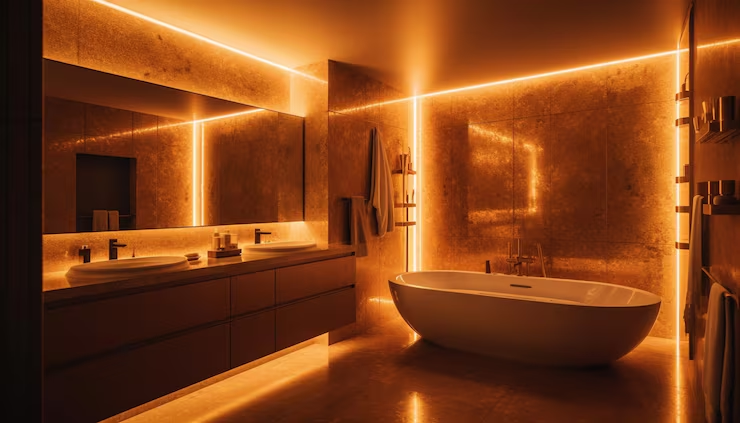
Lighting is the most powerful mood-setter in a bathroom, yet it is often treated as a technical detail rather than an emotional one. The same room can feel cold, rushed, calm, or restorative depending entirely on how light is used.
Most bathrooms are built around function. One bright overhead fixture. Cool-toned bulbs. Sharp reflections. Everything is visible, but nothing feels gentle.
Atmosphere begins the moment light turns on.
The body responds before the mind does.
A harsh glow keeps you alert.
A soft glow invites you to slow down.
Lighting doesn’t just illuminate the room. It tells you how to behave inside it.
Bright Light Creates Urgency
Overhead lighting is efficient. It fills the room quickly and evenly. It’s ideal for cleaning, shaving, and detail-oriented tasks.
But emotionally, it keeps the space in “task mode.”
Bright, cool light:
- Sharpens edges
- Flattens texture
- Increases contrast
- Signals activity
This is why many bathrooms feel clinical. They resemble workspaces more than personal spaces.
When this is the only light source, the room never leaves productivity mode. Even at night, the body remains alert.
The bathroom becomes a place you move through, not a place you pause in.
Soft Light Creates Permission
Soft lighting changes the room’s emotional temperature.
A small lamp on the counter.
A warm bulb near the mirror.
A candle during evening routines.
These sources don’t replace brightness. They complement it.
They allow choice.
You can still use strong light when needed. But when the day is ending, you can let the room exhale.
Soft light:
- Reduces visual tension
- Highlights texture
- Adds depth
- Signals safety
It tells the body that nothing urgent is happening.
The space feels kind.
And kindness changes behavior.
People move more slowly.
They stay longer.
They breathe differently.
The bathroom becomes a place to reset.
Layering Light Creates Balance
The most comfortable bathrooms use more than one type of light.
Instead of relying on a single overhead source, they create layers.
One light for function.
One for atmosphere.
One for accent.
This allows the room to shift throughout the day.
Morning light can be clear and energizing.
Evening light can be warm and low.
The same space serves different needs without changing itself.
Layered lighting feels intentional.
It suggests that the room is designed for more than one state of mind.
Warmth Changes Perception
Color temperature matters.
Cool white light feels clean, but it can also feel distant.
Warm light feels human.
Warm bulbs soften skin tones.
They reduce glare.
They make surfaces feel less rigid.
In a bathroom, warmth counterbalances tile, porcelain, and glass.

The room feels less mechanical.
More lived in.
This is why a single warm lamp can transform a space that otherwise feels sterile.
It adds emotional weight.
It makes the room feel inhabited rather than maintained.
Light Shapes Time
One of the most subtle effects of lighting is how it changes your sense of time.
Bright, even light flattens time.
Everything feels immediate.
Soft, directional light creates pauses.
Shadows appear.
Edges soften.
Movement slows.
The room no longer feels like a corridor between tasks.
It becomes a moment.
This is why spas rely on glow rather than brightness. They use light to remove urgency.
A bathroom can do the same.
Not by becoming dark.
But by becoming gentle.
Atmosphere Is a Message
Every room sends a message.
Lighting is the language.
A brightly lit bathroom says:
“Be efficient.”
A softly lit bathroom says:
“You can take a moment.”
That message is received unconsciously.
Over time, it becomes habit.
People rush in bright rooms.
They linger in gentle ones.
The room teaches behavior.
Why This Matters
The bathroom is one of the few spaces you visit at the beginning and end of every day.
Lighting shapes those transitions.
It can make mornings feel abrupt.
Or it can make them feel grounded.
It can make evenings feel rushed.
Or it can help them unwind.
Changing light doesn’t change the room.
It changes the experience of time inside it.
And that is what atmosphere truly is.
AI Insight: Over time, people often notice that the most calming spaces are not the darkest ones, but the ones where light feels gentle enough to remove any sense of urgency.


