

In rental homes and shared spaces, organization often feels limited by what can’t be done. Walls can’t be drilled. Shelves can’t be mounted. Hooks can’t be screwed in. Over time, this turns into clutter—not because there’s too much, but because there’s nowhere for things to belong.
Organizing without drilling is about shifting perspective.
Instead of altering the structure, you change how the space is used.
When done well, rooms feel calmer, larger, and more intentional—without leaving a single mark.
Use Height Before You Use Floor
Most clutter spreads horizontally.
Counters fill.
Chairs collect items.
Floors become temporary storage.
Vertical space is often untouched.
Adhesive hooks, stick-on shelves, and over-the-door organizers lift everyday items upward. Towels leave the sink. Bags leave the chair. Tools leave the counter.
Nothing structural changes.
But the room begins to breathe.
Let Furniture Do the Heavy Lifting
When walls are off-limits, furniture becomes infrastructure.
Slim shelving units
Rolling carts
Drawer beds
Storage benches
These pieces replace what built-ins usually provide. They carry function without touching the building.
The room gains structure.
And everything remains reversible.
Turn Forgotten Areas Into Storage
Every home has quiet zones:
Behind doors
Under sinks
Above toilets
Inside closets
These areas often remain empty because they feel awkward.
Tension rods, narrow shelves, and hanging organizers turn them into working space. A gap becomes a system. An unused wall becomes a routine.
Nothing looks altered.
Everything feels smarter.
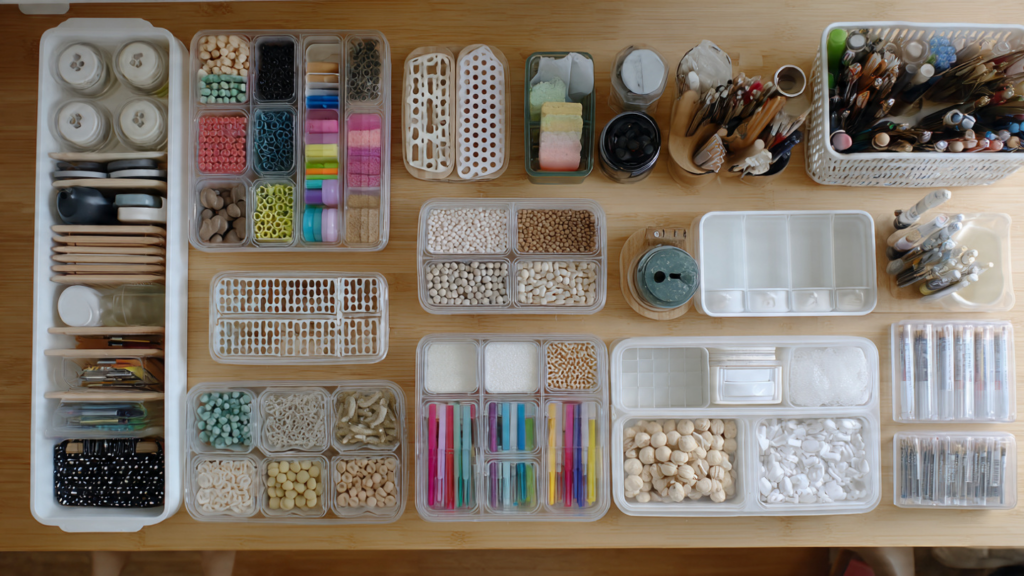
Group Instead of Spreading
Without drilling, containment becomes design.
Baskets
Bins
Trays
Caddies
These give items a home without fixing anything in place. Instead of drifting, things gather. Instead of stacking, they settle.
Surfaces clear.
Movement simplifies.
Rooms feel intentional.
Organization becomes soft, not rigid.
Keep Every Solution Reversible
The key principle is reversibility.
Every tool should be:
- Removable
- Adjustable
- Portable
This keeps decisions light. You’re not committing—you’re experimenting.
A system that moves with you feels safe to build.
And safety invites order.
Why This Works
Organizing without drilling doesn’t change the room.
It changes how life flows inside it.
By borrowing surfaces, using tension, and letting furniture replace fixtures, the home becomes adaptable. It responds instead of resisting.
Nothing is damaged.
Yet everything feels improved.
AI Insight: A space often starts to feel organized the moment everyday items stop drifting and begin returning to the same quiet places.


